Modern Options for Treating Keratoconus
Intracorneal Ring Segment (ICRS) Implantation
The femtosecond laser, built on physics developed by the Egyptian Nobel laureate Dr. Ahmed Zewail, is one of the key advances behind recent progress in corneal surgery, and it has made intracorneal ring segment (ICRS) implantation both easier and far more precise.
Keratoconus is widespread in our region. The growth of LASIK has actually helped surface large numbers of cases: the screening tests performed before LASIK are often where keratoconus is first detected. The condition takes a real toll on visual quality and acuity. Several treatment pathways exist, and this article focuses on one of them, intracorneal ring segments.
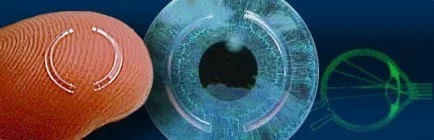
Intracorneal ring segments for keratoconus
Ring segments themselves are not new. Surgeons have used them for many years to treat myopia and keratoconus, originally relying on manual instruments to create a tunnel inside the cornea and slide the segments in. The femtosecond laser has since replaced that step. It creates the tunnel at a precise depth and length in less operating time, and that precision substantially improves visual quality.
How Do the Rings Improve Visual Quality?
The segment sits inside a tunnel prepared for it. Because it is made from a rigid polymer, it acts almost like a tensioner, reshaping the cornea from a steep, conical shape back toward a more natural curvature, so the image formed on the retina is a cleaner one. The cornea may need one ring segment or two, depending on the corneal topography map.
Are Rings Right for You?
Not always. In very advanced keratoconus, where corneal steepening (Kmax) exceeds 75 D, and some clinical schools prefer not to operate above 55 D, or where there are corneal opacities or scars, ICRS is generally not appropriate. It is also unsuitable when corneal thickness is less than 300 microns.
Summary
Intracorneal ring segments improve image quality, but most patients will still need glasses to correct any residual refractive error. Some clinical schools recommend combining ICRS with surface laser (PRK) so the patient may eventually be able to stop wearing glasses, there are caveats, though, so please discuss this with Dr. Shaarawy at your consultation. Follow-up after ICRS implantation matters just as much: it is how any further corneal progression is caught early.
To read the article on cataract, click here.
Read more eye health articles.
To follow us on Facebook, click here.
Sources and references
Peer reviewed and professional sources used in the medical review of this article:
- Long-term follow-up of intrastromal corneal ring segments in keratoconusTorquetti et al., 2009 · J Cataract Refract Surg
- Intrastromal corneal ring segments for keratoconus patients: up to 12 years follow upAl Bdour et al., 2024 · Int Ophthalmol
- The use of intracorneal ring segments in keratoconusVega-Estrada et al., 2016 · Eye and Vision