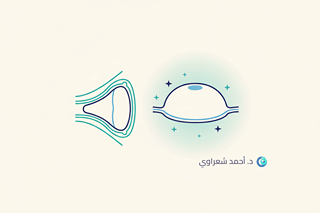
Keratoconus treatment is a journey for everyone diagnosed with the disease, and "journey" is the right word, because keratoconus is progressive and each stage requires its own management. Early on, glasses are usually enough. Over time, the patient may need rigid contact lenses. In the more advanced stages, some patients eventually require a corneal transplant. This article walks through every option used to treat keratoconus and which one fits each stage, so we recommend reading to the end.
📖 The full treatment plan
This article is part of a series. For treatment by stage and the cost of each option, read Keratoconus treatment in Egypt with a cornea specialist: every stage, ICRS, CXL and prices →
Who Is the Keratoconus Patient?
A keratoconus patient is someone whose cornea becomes weaker and thinner, until it can no longer hold its normal shape and gradually takes on a cone-like form. The result is a range of visual problems, and the condition is known as keratoconus.
It typically appears in the late teenage years through the early twenties. Visual symptoms then worsen slowly over a 10- to 20-year period.
Causes of Keratoconus
The exact cause is still unknown, but about 1 in 10 patients with keratoconus has a family member with the same condition. The known risk factors include:
1- Genetic predisposition.
2- This may sound surprising, but eye rubbing, particularly in children, is one of the most important triggers of disease progression.
3- Connective tissue disorders such as Marfan syndrome and Ehlers-Danlos syndrome.
4- Allergic eye disease.
With the causes covered, let's move on to the treatment options and the symptoms.
Treatment Options for Keratoconus
Because keratoconus is progressive, treatment depends on the stage reached. Here is each stage and the management that fits it.
Stage 1, Early Keratoconus
Mild corneal distortion with minimal or no impact on visual quality, and minimal or no progression.
Treatment at this stage
Glasses are usually enough to correct the myopia and astigmatism and provide adequate vision. Soft contact lenses, spherical or toric, can be a good option for general use or for sports activities.
Stage 2, Moderate Keratoconus
Corneal changes are now noticeable. Distortion increases, and vision drops even with glasses.
The treatment at this stage is rigid gas-permeable (RGP) contact lenses.
An RGP lens covers the irregular cornea with a smooth, rigid front surface, neutralising about 90% of the corneal distortion. Its refractive power can also correct any associated myopia, hyperopia or astigmatism. Patients notice better contrast, much less glare and ghosting, and clearer vision overall.
Stage 3, Advanced Keratoconus
Significant corneal distortion is present, with moderate keratoconic changes and mild to moderate corneal scarring. Lens fitting is similar to moderate keratoconus, but the rigid gas-permeable lens design often needs adjusting, steeper inner curvatures to maintain a proper fit. Larger, scleral or hybrid lenses can also help on irregular corneas, since they vault over the cornea and improve stability and comfort.
Severe Keratoconus
Marked corneal distortion, significant scarring, and severe thinning. Vision is often poor even with rigid gas-permeable contact lenses, tolerance to lenses is reduced, and a successful rigid lens fit is usually very difficult to achieve.
Treatment of keratoconus at this stage: corneal transplantation, performed by a surgeon specialised and experienced in transplants for keratoconus.
What Are the Symptoms of Keratoconus, and When Do Patients Notice Them?
Keratoconus typically begins to appear in the late teens through the early twenties, and visual symptoms worsen slowly over a 10- to 20-year period.
It often affects both eyes,
and can leave a significant difference in vision between the two. Symptoms vary between eyes and can change over time.
In the early stages, symptoms can include:
- Mild blurring of vision.
- Slight visual distortion, where straight lines appear bent or wavy.
- Increased sensitivity to light and glare.
- Eye redness or swelling.
In advanced stages the picture changes, and the patient may notice:
- Marked visual distortion even with glasses.
- Visible spots on the eye.
- Severe light sensitivity even when wearing rigid contact lenses.
Keratoconus Treatment in Egypt: Why Patients Choose Dr. Shaarawy
Over the years, Dr. Ahmed Shaarawy has treated hundreds of patients seeking corneal transplantation and keratoconus treatment, for the following reasons:
- Dr. Shaarawy is a corneal surgery specialist with a doctorate (MD) in ophthalmology and a fellowship from the Devers Eye Institute, USA.
- He was the first to introduce S-DMEK in Egypt.
- Two of his surgical techniques are in the American Academy of Ophthalmology video library.
Sources and references
Peer reviewed and professional sources used in the medical review of this article:
- Keratoconus: An updated reviewSantodomingo-Rubido et al., 2022 · Contact Lens & Anterior Eye
- Corneal collagen cross-linking for treating keratoconusSykakis et al., 2015 · Cochrane Database Syst Rev
- A randomized, controlled trial of corneal collagen cross-linking in progressive keratoconus: three-year resultsWittig-Silva et al., 2014 · Ophthalmology