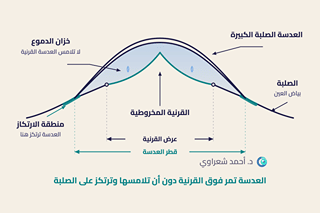
ICRS implantation is one of the most accessible modern options for managing keratoconus.
Keratoconus today is treated with laser-based techniques. Interestingly, femtosecond laser technology, the foundation of much of modern corneal surgery, was pioneered in part through the work of the late Egyptian Nobel laureate Dr. Ahmed Zewail.
Laser-based corneal surgery has done more than almost anything else to advance keratoconus treatment in recent years. Procedures such as ICRS implantation are now faster, safer, and more precise, which matters especially in the Middle East, where keratoconus is unusually common.
Modern laser-based corneal imaging has helped too, catching many cases that were previously missed. These are typically picked up during routine pre-op screening for refractive surgery, which often reveals subclinical keratoconus.
This article walks through one of the most effective modern options for managing keratoconus and its impact on visual quality: intracorneal ring segments (ICRS).
What Is ICRS Implantation for Keratoconus?
Corneal Ring Implantation for Keratoconus
Implanting rings in the cornea isn't new. Corneal rings have been used for years, both to manage refractive issues such as low-degree myopia and to treat keratoconus.
What has changed is how it's done. Originally, ring implantation was performed manually with surgical instruments. With femtosecond laser technology, the procedure has become far simpler and far more precise: the laser creates exact tunnels within the cornea, and the ring segments are placed into them.
The laser has shortened operative time and sharply increased the accuracy of the procedure, and that precision translates directly into better visual outcomes for patients.

ICRS implantation for keratoconus
How Do Corneal Rings Improve Vision?
The rings are made of a rigid, biocompatible material that acts like a tensioner inside the cornea. Once implanted into the laser-created tunnel, they reshape the cornea, flattening the steep, cone-shaped curvature of keratoconus back toward a more normal contour. That change in shape is what improves visual quality and image clarity.
How many segments? That's decided by the corneal topography map for that specific eye.
Will you still need glasses? Possibly, ICRS implantation doesn't always eliminate the need for correction, and some patients keep glasses for residual refractive error. And if the keratoconus shows signs of progressing, the case should go back to the corneal specialist for review.
The ICRS Procedure for Keratoconus
ICRS implantation should always be done by a surgeon who specializes in corneal surgery and keratoconus management, that's essential for consistent, high-quality outcomes. The procedure demands a high level of surgical precision, which is why your choice of clinic matters. At Cornea Clinic, Dr. Ahmed Shaarawy, Lecturer and Consultant of Cornea and Refractive Surgery, specializes in corneal transplantation, ICRS, and keratoconus management.
The rings improve visual quality, but glasses may still be needed to fine-tune any remaining refractive error.
Sources and references
Peer reviewed and professional sources used in the medical review of this article:
- Changes in the quality-of-life of people with keratoconus (CLEK)Kymes et al., 2008 · Am J Ophthalmol
- Mini-Scleral Lenses Improve Vision-Related Quality of Life in KeratoconusKreps et al., 2021 · Cornea
- Quality of life and vision assessment with scleral lenses in keratoconusHadimani et al., 2024 · Saudi J Ophthalmol