What Makes Scleral Lenses Different?
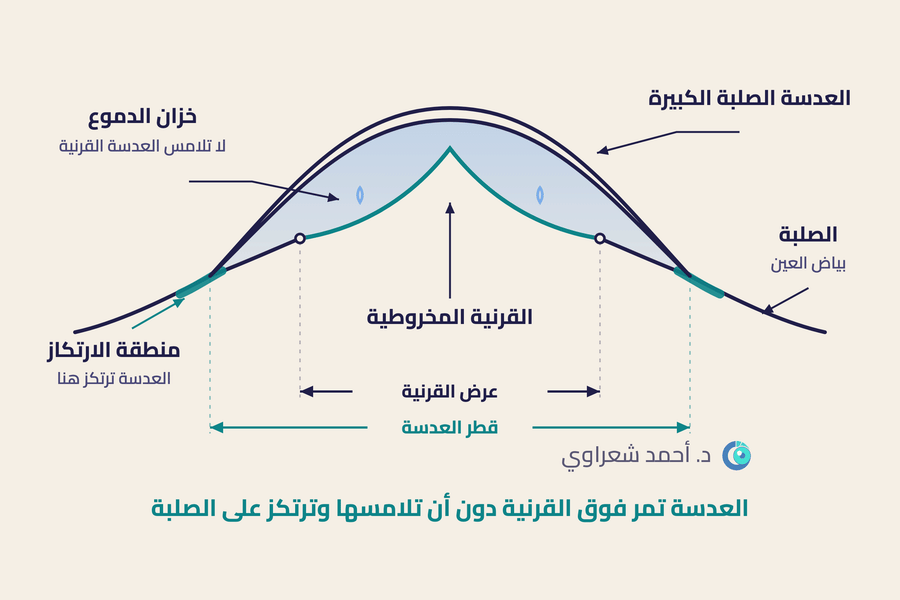
Scleral lenses are large-diameter rigid contact lenses (15-24 mm). Unlike ordinary lenses, they rest on the white of the eye, the sclera, rather than directly on the cornea. The gap between lens and cornea is filled with saline solution, which creates a smooth, spherical optical surface in front of the distorted cornea.
Why Are They Best for Advanced Keratoconus?
Because they simply bypass the problem. Light passes through the lens's smooth surface and the saline beneath it, ignoring the irregular corneal shape underneath entirely. They are also more comfortable to wear than small rigid (RGP) lenses, and they keep the cornea continuously hydrated.
Comparing Lens Options
Glasses only help in the early stages. RGP lenses correct well but offer moderate comfort. Hybrid lenses suit moderate stages. For advanced cases, scleral lenses are the best option visually and the most comfortable to wear.
Do They Replace Surgery?
No, and this matters. Scleral lenses neither halt the disease's progression nor treat it; they are an excellent compensatory visual solution. Some patients live comfortably with them for years, while others ultimately need ring implantation or a corneal transplant.
For an evaluation and a scleral lens trial, contact Dr. Ahmed Shaarawy's clinic.
Sources and references
Peer reviewed and professional sources used in the medical review of this article:
- Long-Term Effectiveness of Scleral Lens Treatment in the Management of Keratoconus: A Systematic ReviewMushtaq et al., 2025 · Cureus
- Safety and Efficacy of Scleral Lenses for KeratoconusFuller et al., 2020 · Optom Vis Sci
- Mini-Scleral Lenses Improve Vision-Related Quality of Life in KeratoconusKreps et al., 2021 · Cornea