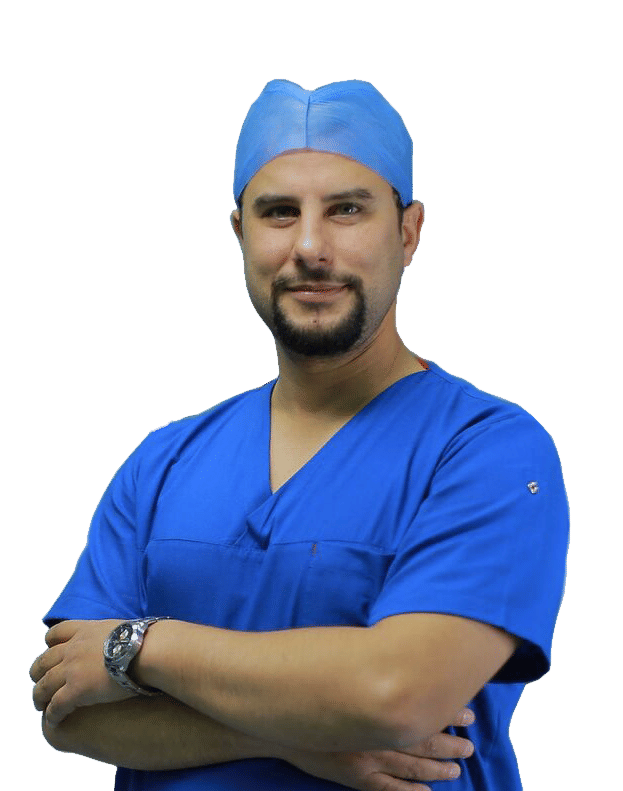
DMEK and S-DMEK in Cairo: by the surgeon who introduced S-DMEK in Egypt.
DMEK (Descemet Membrane Endothelial Keratoplasty) replaces only the inner endothelial layer of the cornea, the gold standard for Fuchs dystrophy and endothelial failure. Dr. Ahmed Shaarawy was the first to introduce S-DMEK in Egypt, after training under Prof. Mark A. Terry at Devers Eye Institute, Portland, one of the original developers of the technique. From $3,000.
Why choose us
International standard. Regional access.
Fellowship under Prof. Mark A. Terry
Devers Eye Institute, Portland, Oregon, where modern DMEK was developed. Direct training in the original technique from one of its inventors.
First to introduce S-DMEK in Egypt
Dr. Shaarawy introduced the S-DMEK variant, using a tissue stamp to prevent the donor membrane from being implanted upside-down. A meaningful safety improvement.
AAO 2014 poster on DMEK outcomes
Co-author on the AAO 2014 poster showing DMEK improves vision even in eyes with prior refractive surgery, a notoriously challenging patient group.
Lowest rejection rate of any transplant
DMEK carries the lowest rejection risk of any keratoplasty: the probability of an immune reaction at four years was 2.3% across 1,000 consecutive eyes (Hos et al., Ophthalmology 2017), and DMEK's risk is significantly lower than DSAEK or PKP (Anshu, Price & Price, Ophthalmology 2012). Because only the thin inner layer is replaced, the immune response is minimized. See the references below.
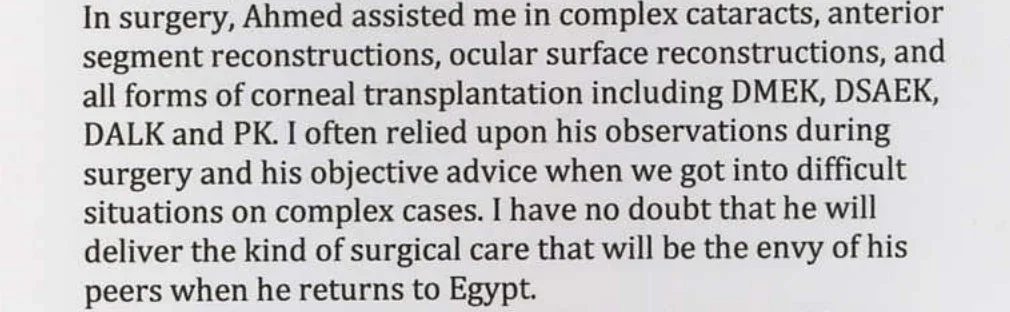
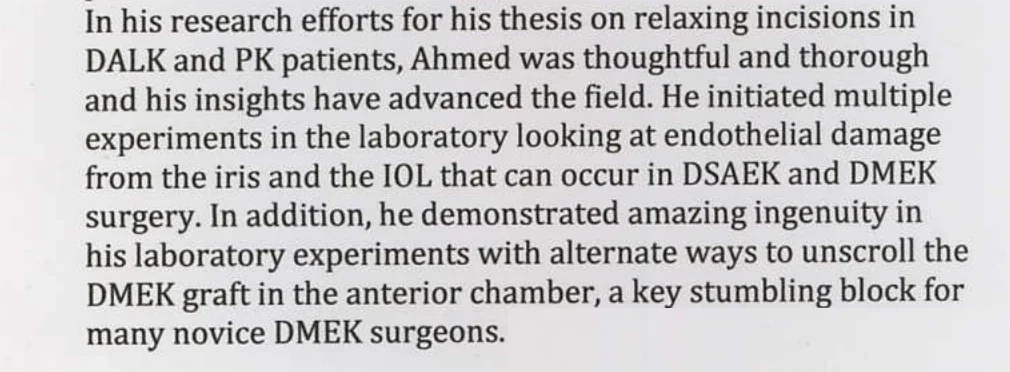
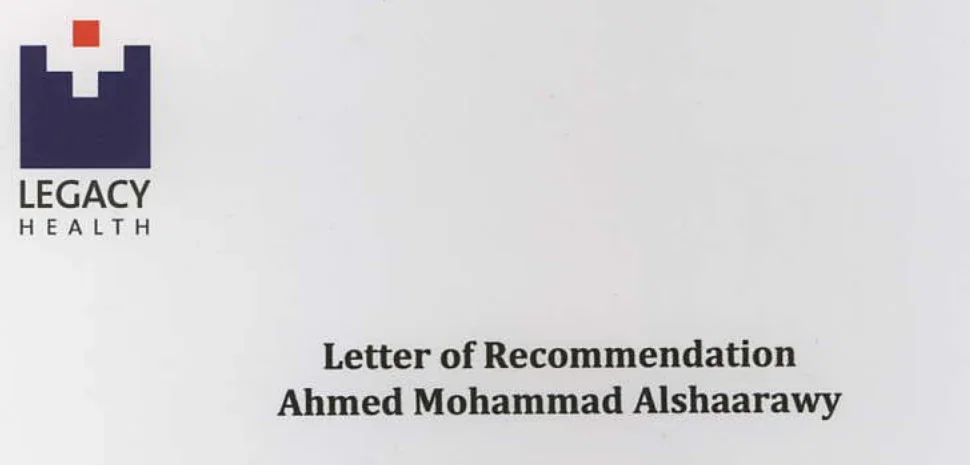
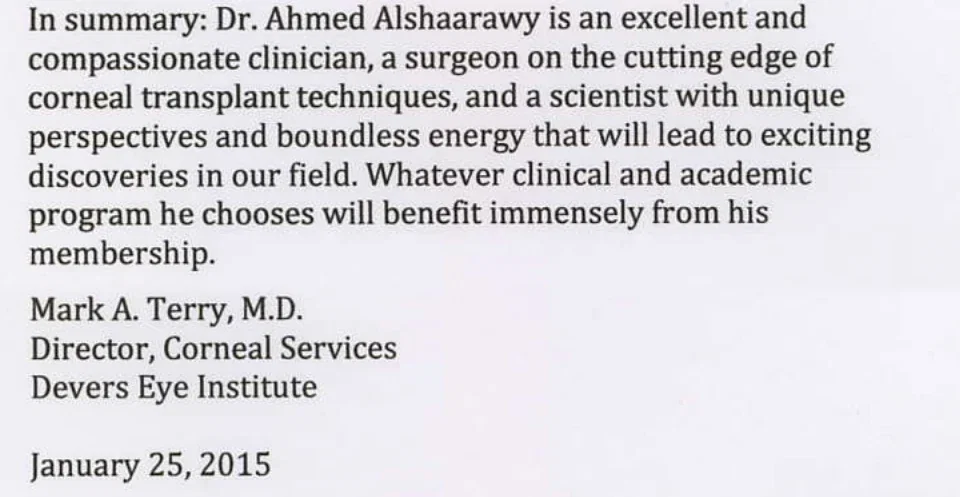
Letter of recommendation
In Prof. Mark Terry's own words
Excerpts from the letter Prof. Mark A. Terry, Director of Corneal Services at the Devers Eye Institute, wrote for Dr. Shaarawy on 25 January 2015, at the end of his time in Portland.
Tripoli, March 2022
Libya's national corneal transplant programme
Visiting surgeon for the programme the Libyan Ministry of Health launched at Tripoli University Hospital: about 20 corneal transplants in one week, restarting the surgery there after a pause of nearly eight years.
The full story and sourcesHolding the air in my hands: DMEK by air
Kholoud, from Baghdad, could hardly see with her eye and could not climb stairs. She found Dr. Ahmed Shaarawy on Facebook and had a stitch-free DMEK by air in Erbil.
"Now you know that I really did hold the air in my hands."
Procedures & pricing
Transparent USD pricing.
Final cost is set after clinical examination. Local-currency equivalents available on request. Insurance reports issued for international patients.
| Procedure | Best for | From (USD) |
|---|---|---|
| S-DMEK (S-stamp DMEK) | Marked with an S-stamp for orientation, eliminates the risk of upside-down implantation. | $3,000 - $3,500 |
| Standard DMEK | Conventional DMEK technique. Used when S-stamp preparation isn't available. | $3,000 - $3,500 |
| DMEK + cataract surgery (triple procedure) | DMEK combined with phaco + IOL in a single session. Common in Fuchs patients with cataract. | $3,400 - $3,900 |
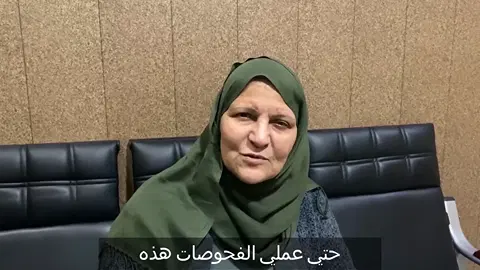
Watch a real patient's experience with Dr. Ahmed Shaarawy
A real patient talks through the whole thing, from diagnosis to restored vision after DMEK corneal transplantation.
Common questions
Frequently asked.
Why DMEK instead of DSAEK?
How long is recovery after DMEK?
What's the rejection risk for DMEK?
I have Fuchs dystrophy: am I a candidate?
Where does the donor tissue come from?
How does DMEK in Cairo compare to DMEK in Europe or the US?
Can I have DMEK if I had LASIK or RK before?
What's the risk of needing a second air-bubble (re-bubble) after DMEK?
Book your consultation
Pick a day and time. The first visit is an eye exam with Dr. Ahmed Shaarawy, who tells you which option suits your eyes.
Discuss your case with the surgeon who introduced S-DMEK in Egypt.
Send your specular microscopy, OCT, and recent topography. We'll respond within 24 hours with whether DMEK, DSAEK, or another approach is right for you, the all-in cost, and a recommended travel plan.
Medical references
- Hos D, Tuac O, Schaub F, et al. "Incidence and Clinical Course of Immune Reactions after Descemet Membrane Endothelial Keratoplasty: Retrospective Analysis of 1000 Consecutive Eyes." Ophthalmology. 2017;124(4):512-518. PMID: 28094043. probability of an immune reaction 2.3% at four years.
- Anshu A, Price MO, Price FW Jr. "Risk of corneal transplant rejection significantly reduced with Descemet's membrane endothelial keratoplasty." Ophthalmology. 2012;119(3):536-540. PMID: 22218143. rejection risk after DMEK significantly lower than after DSEK or penetrating keratoplasty.
- Dr. Ahmed Shaarawy: 20+ years of corneal and refractive surgery, Devers Eye Institute fellowship (Portland, Oregon), two surgical techniques in the AAO video library. The figures on this page come from the published literature, not from this clinic's own patients.