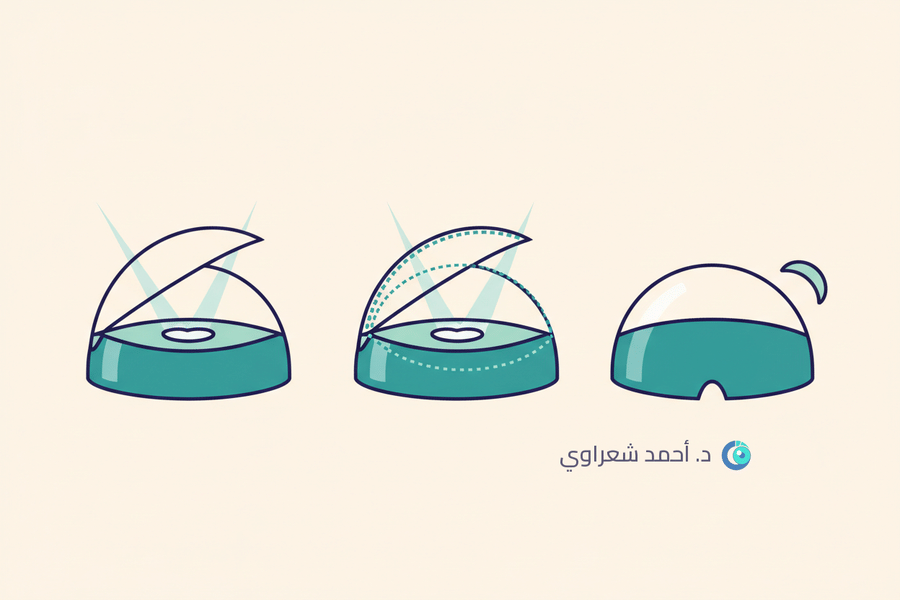
LASIK vs Femto-LASIK vs SMILE Pro
Several procedures are used today to correct refractive errors such as hyperopia (farsightedness), myopia (nearsightedness), and astigmatism. Newer laser techniques have widened the options considerably, chiefly LASIK, Femto-LASIK, and SMILE Pro. So what actually separates the three, and how do you choose the procedure that is best for your eyes?
The points below walk through the key differences, so you can see how LASIK, Femto-LASIK and SMILE Pro compare.
At Dr. Shaarawy's clinics, all refractive procedures are performed using the latest laser platforms.
Standard LASIK
Conventional LASIK corrects refractive errors by reshaping the curvature and thickness of the cornea, so incoming light lands precisely on the retina and vision sharpens again.
Not every eye qualifies, though. Some are unsuitable for standard LASIK, and the surgeon may instead recommend Femto-LASIK or SMILE Pro, and the surgeon may recommend Femto-LASIK or SMILE Pro instead. Examples include:
- Keratoconus.
- Thinner-than-average corneal thickness.
Femto-LASIK
Femto-LASIK is a more advanced version of conventional LASIK. The key difference from standard LASIK is the flap: instead of a mechanical microkeratome blade, a femtosecond laser separates the corneal layers. That single change brings several advantages:
- Femto-LASIK can be performed on eyes with thinner corneas where standard LASIK would not be safe.
- The accuracy of refractive correction tends to be higher.
- Recovery time is shorter than with standard LASIK.
- Visual quality after the procedure is consistently better than with conventional LASIK.
Is Femto-LASIK Suitable for Every Patient?
Femto-LASIK is suitable for most patients who would qualify for standard LASIK, and it can also be performed in some cases where standard LASIK is not, for example, eyes with thinner corneal thickness or steeper-than-average corneal curvature.
SMILE Pro
SMILE Pro corrects refractive errors too, much like LASIK and Femto-LASIK.
In SMILE Pro, a femtosecond laser carves a small, lens-shaped piece of tissue (a lenticule) within the cornea, without lifting a flap as in LASIK.
SMILE Pro parts ways with Femto-LASIK on one point: no corneal flap is created at all. The laser works through a tiny incision instead.
What Is the Difference Between Femto-LASIK and SMILE Pro?
Femto-LASIK still creates a corneal flap, but a femtosecond laser separates the corneal layers instead of a mechanical blade, and the tissue underneath is then reshaped. SMILE Pro creates no flap at all: the femtosecond laser carves a small, lens-shaped piece of tissue (a lenticule) inside the cornea and removes it through a tiny incision. Because the flap step is gone, SMILE Pro tends to be preferred for thin corneas, steep corneal curvature, high myopia and low astigmatism, while Femto-LASIK remains a strong option for many other eyes. Dr. Shaarawy decides between them from each eye's thickness, curvature and refractive error.
When Is SMILE Pro Used?
SMILE Pro can correct myopia in cases that may also be candidates for LASIK, including:
- Eyes with very thin corneas where neither LASIK nor Femto-LASIK is appropriate.
- Patients with very high degrees of myopia.
When Is SMILE Pro Better Than Femto-LASIK?
Both SMILE Pro and Femto-LASIK each have their own indications. SMILE Pro tends to win out when the following apply:
- Thin corneal thickness.
- Steep corneal curvature.
- High degree of myopia.
- Low astigmatism.
In these cases, SMILE Pro is often the preferred option, discuss your individual eyes with Dr. Shaarawy to settle on the best procedure for you.
In the end, the choice between LASIK, Femto-LASIK, and SMILE Pro comes down to the condition of each individual eye: corneal curvature, corneal thickness, refractive error, and other factors that vary from patient to patient. Your surgeon will recommend whichever technique is safest and most accurate for your corneas.
Sources and references
Peer reviewed and professional sources used in the medical review of this article:
- Clinical Outcomes of SMILE and FS-LASIK Used to Treat Myopia: A Meta-analysisZhang et al., 2016 · J Refract Surg
- SMILE versus FS-LASIK for high myopia: a meta-analysisFu et al., 2021 · PLoS One
- LASIK: Laser Eye SurgeryAAO EyeSmart, 2026 · aao.org