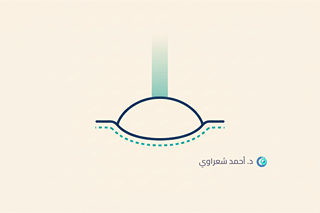
LASIK Surgery in Egypt: From a Cornea Surgeon Who Sees the Full Picture
A few months ago, a patient came to see me from Saudi Arabia, 34 years old, a bank employee. He had myopia of -5.5 in the right eye and -6 in the left, and had worn glasses since elementary school. He told me: "Doctor, I'm planning to get LASIK in Egypt, but every time I ask around, I get conflicting answers. I just want someone to tell me the truth." I said, "Let's start with the exam and see what your eyes tell us."
After an hour-long full workup, we did Femto-LASIK the next day. Within 24 hours, he was seeing 20/20 in both eyes. But the story isn't always that simple, and that's exactly what you'll learn in this article.
What Exactly Is LASIK?
LASIK stands for Laser-Assisted In Situ Keratomileusis, essentially, reshaping the cornea with a laser. The cornea is the clear, curved layer at the front of the eye, responsible for focusing light onto the retina. When its shape isn't quite right, light focuses in the wrong place, causing:
- Myopia (nearsightedness): You see close-up well but distance is blurry, light focuses in front of the retina.
- Hyperopia (farsightedness): Your eye strains to focus up close, light focuses behind the retina.
- Astigmatism: The cornea is shaped more like an oval than a sphere, images arrive doubled or distorted.
LASIK reshapes the cornea with computer-guided precision to correct this. Most patients are able to give up glasses permanently.
The Difference Between Traditional LASIK, Femto-LASIK, and SMILE
This is the question I get asked most in clinic. The core difference is how the corneal surface is handled:
1. Traditional LASIK
Uses a mechanical device (a microkeratome) to cut a thin flap in the corneal surface. The technique has proven itself over decades, but flap thickness is less precise than with a laser.
2. Femto-LASIK
Same concept, but the flap is created with a femtosecond laser instead of a blade. It gives me finer control over the flap's thickness and diameter, and puts less pressure on the eyeball. It's my preferred option for most cases.
3. SMILE
No flap is created at all. The laser shapes a small disc of tissue (a lenticule) inside the cornea, which is removed through a tiny opening. The result: a more stable corneal surface and less dryness. It suits some patients whose corneal thickness isn't enough for Femto-LASIK. If you want to go deeper into it, read the article Femto-SMILE: Everything You Need to Know About SMILE Surgery.
Quick Comparison
| Criteria | Traditional LASIK | Femto-LASIK | SMILE |
|---|---|---|---|
| Flap tool | Microkeratome | Femtosecond laser | No flap |
| Recovery speed | 1-2 days | 1-2 days | About a week |
| Dry eye | Possible | Less likely | Least likely |
| Best for | Simple cases | Most cases | Relatively thin corneas |
| Approximate cost | $300-500 both eyes (EGP 14,700-24,500) | $600-1,100 both eyes (EGP 29,400-53,900) | $900-1,400 both eyes (EGP 44,100-68,600) |
"There's no type that's better than another in absolute terms. There's a type that's better for you, determined by your corneal thickness, your prescription, and your lifestyle. If someone tells you 'SMILE is the best option for everyone,' they're selling you something."
Are You a Candidate for LASIK?
Not every eye is suitable. My initial exam takes an hour to an hour and a half and covers a complete evaluation.
Basic Requirements
- Age: Over 18, ideally 21+, with your prescription stable for at least a year.
- Corneal thickness: Must be above a safe threshold, determined during the exam.
- No keratoconus: This is an absolute contraindication for LASIK. Topography detects it even at an early stage.
- Healthy retina: Any issues need to be treated first.
- No severe dry eye: Dryness tends to worsen after surgery.
Cases That Are Excluded
- Keratoconus or corneal ectasia
- Pregnancy and breastfeeding
- Uncontrolled autoimmune disease
- Certain acne medications (isotretinoin)
- Severe, untreated dry eye
If you're excluded from LASIK, that's not the end of the road. I might recommend PRK or ICL lenses (costing $1,200 per eye, or $1,500 for toric ICL, but excellent for high prescriptions).
Your Journey, From the Exam to Clear Vision
The Comprehensive Exam
Takes one to two hours and includes:
- Corneal topography: A 3D map that detects early keratoconus
- Corneal thickness measurement: Down to the micron
- Pupil size measurement in the dark: A larger pupil increases the likelihood of night halos
- Tear film and dry eye assessment
- Retina exam
Surgery Day, 10 Minutes
- Local anesthetic drops, you won't feel pain
- The eye is gently held in place with a special device
- With Femto: the flap is created by laser within seconds
- The excimer laser reshapes the cornea with micron-level precision
- The flap is repositioned with no stitches needed
You'll notice an immediate improvement in vision, despite some blurriness and mild burning. Within 4-6 hours, vision improves noticeably. Most of my patients wake up the next day seeing the world clearly without glasses for the first time in years.
Recovery Timeline
| Period | What to Expect |
|---|---|
| First 4-6 hours | Tearing, light sensitivity, mild burning, sleep once you get home |
| Day one | Good vision, mild transient blurriness |
| First week | No rubbing the eye, drops on schedule, eye shield at night |
| First month | Vision gradually stabilizes, no swimming or diving |
| 3-6 months | Full stabilization, regular follow-up visits |
The Risks, The Full Picture
As a cornea surgeon, I'm the one who sees LASIK complications when they happen. LASIK is one of the safest elective surgeries in the world, but you should still know:
- Dry eye: The most common side effect. It improves gradually over the first few months with drops. A small percentage of patients are left with chronic dryness.
- Halos and night glare: Especially with larger pupils. Usually improves over time.
- Under- or over-correction: Sometimes needs a later touch-up.
- Flap-related problems: Very rare with Femto-LASIK.
- Corneal ectasia: The most serious complication, but very rare when screening is done properly. I see it in my clinic, and most cases were early keratoconus that wasn't caught on the original exam.
"A thorough exam before surgery is the best safeguard against complications. An experienced surgeon will turn away a patient who isn't a good candidate, rather than gamble with your eye's health."
Why Egypt Is a LASIK Destination
I see patients from Saudi Arabia, Iraq, and Libya, for a combination of reasons you don't find everywhere:
- Cost: Femto-LASIK in Egypt costs a fraction of the same procedure with the same equipment in the Gulf.
- Expertise: Doctors trained in the US and Europe, working with the latest equipment.
- Language and proximity: Shared Arabic and short flights make the trip easy.
Frequently Asked Questions
Is the surgery painful?
No. Anesthetic drops are enough. Afterward you might feel mild burning that goes away after a few hours of sleep.
How long do LASIK results last?
Results are permanent in suitable candidates. Any refractive changes that occur years later are natural changes in the eye, not a failure of the surgery.
When can I go back to work?
Most of my patients return to office work by the second or third day. Jobs involving dust or friction need a longer break, which I determine during the exam.
Does Egypt's heat and dust affect LASIK?
No, there's no issue, as long as you follow the protective instructions for the first few weeks: sunglasses, avoiding dusty areas, and no rubbing the eye.
Can both eyes be done the same day?
Yes, that's standard practice at most specialized centers and is completely safe.
The First Step
If you're considering LASIK, the comprehensive exam is what determines everything, whether you're a candidate, which technique suits you best, and what result to expect. The exam at my clinic in Dokki costs EGP 1,500 and covers all the tests I've mentioned. You can also get an initial cost estimate for your case beforehand using the LASIK cost calculator. And if it turns out your eyes aren't suited to LASIK, I'll tell you honestly and talk through the alternatives with you.
Because my goal isn't just to perform the surgery, it's for your eyes to stay healthy for the long run.
Sources and references
Peer reviewed and professional sources used in the medical review of this article:
- LASIK (patient information hub)U.S. FDA · fda.gov
- Modern laser in situ keratomileusis outcomesSandoval et al., 2016 · J Cataract Refract Surg
- LASIK world literature review: quality of life and patient satisfactionSolomon et al., 2009 · Ophthalmology