What Exactly Are the Four Stages of Keratoconus?
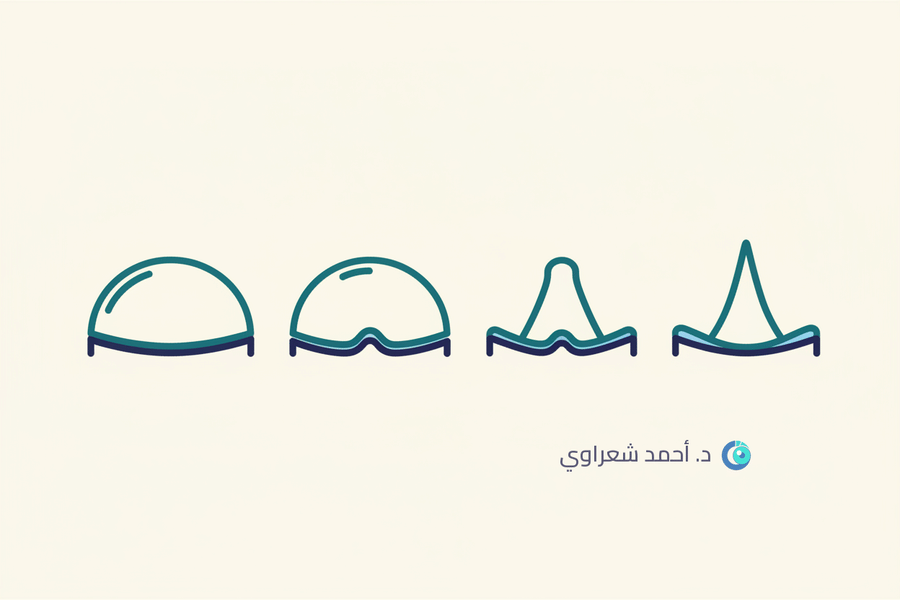
My patients ask me this question a lot: "Doctor, which stage am I in?" The answer matters a great deal, because it is what determines which treatment is right for you, and not just any other treatment. Keratoconus is a progressive disease that develops in stages, and each stage has a different pattern of symptoms and a different degree of corneal bulging. In our clinic we rely on Pentacam topography to determine the stage precisely, not on how it feels or on what the naked eye can see, because the eye can look normal while the cornea inside it has already started to thin and bulge.
Now I will walk you through the four stages we use in the clinical classification (known as the Amsler-Krumeich classification), what the patient notices at each stage, and which treatment suits which stage, based on the data and the prices actually published on our website.
Stage One: Early Keratoconus
This is the hardest stage to diagnose, because the symptoms are mild and are easily confused with ordinary vision problems. The patient notices that the glasses that used to work are no longer enough, and may perceive "halos and rings around car headlights at night", one of the first signs that catches my attention during the examination. The patient may also feel that letters have become "doubled or carry a faint shadow" while reading.
At this stage the cornea still relatively retains its structural strength, and that lets us turn to a simple, conservative treatment: corneal collagen cross linking (Cross Linking, CXL). The idea is that this procedure strengthens the collagen fibres inside the corneal tissue and so stops the disease from progressing. It does not correct the shape that has already developed, but it prevents further deterioration. According to the data published on our CXL cost page, there is more than one protocol: accelerated CXL at 400-560 dollars, conventional CXL (the Dresden protocol) at 500-700 dollars, and Trans-Epi (without removing the outer layer) at 600-800 dollars per eye. The session itself takes about 30 minutes, and initial recovery takes 3 to 5 days with the conventional protocols, or only one to two days with Trans-Epi.
And it is important that I say this to the patient from the outset: CXL does not return vision to normal, it stops the condition from deteriorating. Results may vary from one patient to another depending on how fast the disease is progressing, the patient's age and the degree of keratoconus at the time of diagnosis.
Stage Two: Moderate Keratoconus
At this stage the bulging has become more obvious, and the patient notices that the "distortion and waviness of the letters" is clearer on vision tests, and that glasses can no longer sharpen the vision the way they used to, even when they are changed every so often. That is an indicator that the geometric shape of the cornea has changed, not just its strength.
Here the most suitable treatment is usually corneal rings (ICRS/Intacs). These rings are placed within the thickness of the cornea through a fine tunnel created with the femtosecond laser, "without surgical blades", and their job is to improve the regularity of the corneal surface and correct part of the abnormal curvature. According to the corneal rings cost page, the price ranges from 600 to 1,200 dollars per eye, the surgery itself takes only about 5 minutes per eye, and initial recovery is one to two weeks, until the final result settles over roughly a month. The rings are most often used for early and moderate cases (stage one and stage two), before the cornea becomes too thin.
If you would like to hear real experiences from patients who have had this procedure with me, there are documented video testimonials on the corneal rings patient experiences page, where they talk about their journey from the first examination through to final stability after 3-6 months.
Stage Three: Advanced Keratoconus
At this stage the cornea has become thinner and more bulged, and the patient has usually already tried glasses and ordinary contact lenses without being able to reach clear vision with them. Sometimes the patient describes the vision to me as "blurred or doubled" even with the best optical correction available.
In these cases, and especially when the disease is progressing rapidly, we turn to a combined treatment: CXL + ICRS together, in the same session or a short time apart. The aim is to stop the progression with the collagen and at the same time improve the shape of the surface with the rings. According to the CXL page, the approximate price of the combined package ranges from 1,200 to 1,800 dollars. Combining the two gives us a chance to avoid reaching a stage that requires a corneal transplant, if it is done at the right time.
Stage Four: Severe (Late) Keratoconus
This is the stage I work hard to keep my patients from ever reaching, and it is the basis of everything I say about the importance of early diagnosis. In the severe stage the cornea has thinned a great deal and scarring (fibrosis) may develop in the tissue, and sometimes a condition called hydrops (acute corneal oedema), a sudden accumulation of fluid inside the cornea that causes opacity and acute pain. In this situation the rings and CXL no longer have a sufficient role, and the patient often cannot see clearly even with rigid contact lenses.
The definitive treatment here is a partial corneal transplant (DALK). In this procedure we replace the diseased front layers of the cornea with healthy donor tissue, while preserving the inner layer (the endothelium) if it is still healthy, and that is what distinguishes DALK from a full transplant (PKP), which is reserved for the most end-stage cases. According to the keratoconus page and the corneal transplant cost page, the price of DALK ranges from 2,500 to 3,000 dollars (about 122,000-147,000 Egyptian pounds), the surgery takes about 45 minutes, but recovery is much longer: 6 to 12 months until the final result fully settles.
And I want to make one thing clear here: after DALK, results may vary from one patient to another depending on the state of the cornea before surgery and on individual healing speed, but the success rate of the procedure is very high as a definitive solution for advanced cases.
And Why Is Early Diagnosis With the Pentacam So Important?
If you noticed a thread running through everything above, it is this: the earlier we detect the disease, the simpler, cheaper and less surgically invasive the treatment becomes. The difference between a simple CXL at stage one and a full corneal transplant at stage four is not only a difference in cost, it is a difference in the patient's quality of life as well.
The Pentacam gives us a precise topographic map of the corneal surface: its thickness at every point, its degree of curvature and the direction of the bulge, and that lets me determine the stage precisely even when the patient does not yet have clear symptoms. If you have a family history of the disease, or you rub your eyes repeatedly and excessively, or your vision keeps changing every short while, it is better to have a topographic examination early instead of waiting for the symptoms to appear.
Frequently Asked Questions About the Stages of Keratoconus
Can I move from one stage to the next quickly?
The speed varies from one patient to another. In teenagers and young adults the disease can progress faster because of growth hormones and constant eye rubbing, so for early cases we recommend regular follow-up with the Pentacam every 6 months, so that we catch any progression early.
Can I have CXL at an advanced stage?
It can be combined with the rings at stage three, as we explained, but at stage four (severe) its effect is very limited, because the cornea has become thinner than the safe limit for the procedure, and here the focus is on transplantation.
Are rigid (scleral) contact lenses an alternative to surgery?
In some moderate cases, large rigid lenses (scleral lenses) can improve the quality of vision noticeably without surgery, because they create a "fluid layer" over the irregular corneal surface and correct a large part of the visual distortion. But they are a corrective solution, not a curative one, meaning they do not stop the disease from progressing the way CXL does, so we mostly use them as a temporary or complementary option, not as a substitute for the main treatment that suits the stage of the case.
Does a corneal transplant mean I will lose my sight permanently if it fails?
No. DALK is a well documented procedure with a high success rate as a definitive solution for advanced cases. The most important part is that the recovery period is long (up to a year) and needs patience and regular follow-up, but results may vary from one patient to another depending on the state of the cornea and on adherence to the post-operative instructions.
If you are not sure which stage you are in, the first step is always a topographic examination with the Pentacam. You can read more about the symptoms, the diagnosis and the treatments in detail on our keratoconus page.
Sources and references
Peer reviewed and professional sources used in the medical review of this article:
- Keratoconus: The ABCD Grading SystemBelin et al., 2016 · Klin Monbl Augenheilkd
- Global consensus on keratoconus and ectatic diseasesGomes et al., 2015 · Cornea
- Keratoconus: An updated reviewSantodomingo-Rubido et al., 2022 · Contact Lens & Anterior Eye