
DSAEK in Cairo: the safer alternative when DMEK isn't possible.
DSAEK (Descemet Stripping Automated Endothelial Keratoplasty) is the right choice when the eye's anterior segment is too complex for DMEK, for example after prior glaucoma tubes, a very shallow chamber, or aniridia. It transplants a thin layer of stroma along with the endothelium, which makes it easier to handle in complex eyes. From $3,500.
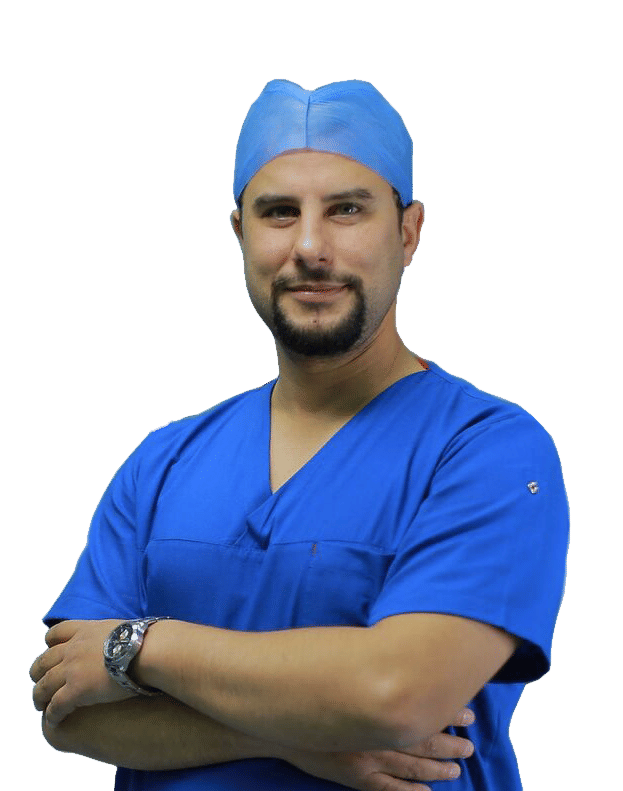
Why choose us
International standard. Regional access.
Devers Eye Institute fellowship
Trained directly under Prof. Mark A. Terry, one of the original developers of DSAEK. Same technique, same protocols.
When DMEK isn't safe, DSAEK is
DSAEK is forgiving. The thicker tissue makes it the right choice for complex eyes, prior glaucoma tubes, very shallow anterior chambers, aniridia, infant cases.
Faster than full corneal transplant
DSAEK preserves the front surface of the cornea, no full-thickness incision, no sutures across the whole graft. Visual recovery is much faster than PKP.
Internationally sourced tissue
Donor tissue imported from VisionGift, Saving Sight (USA), or European eye banks. Full chain-of-custody documentation, ≤48h sourcing.
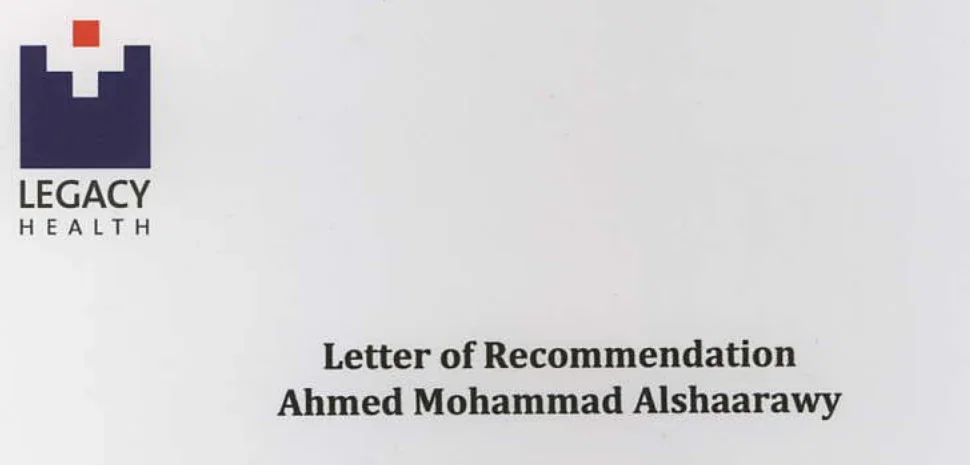
Letter of recommendation
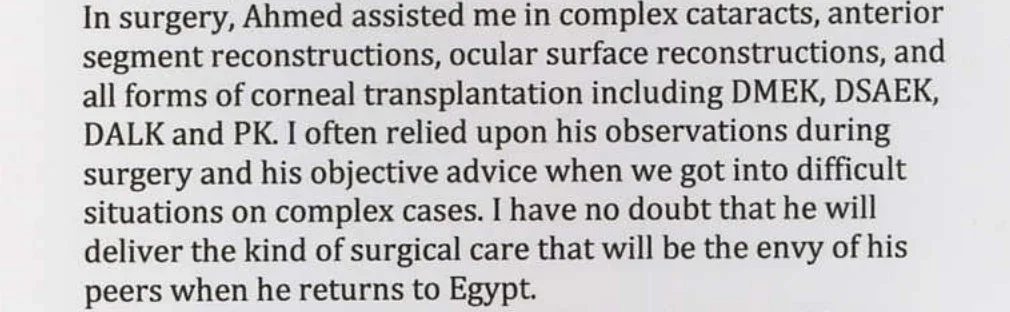
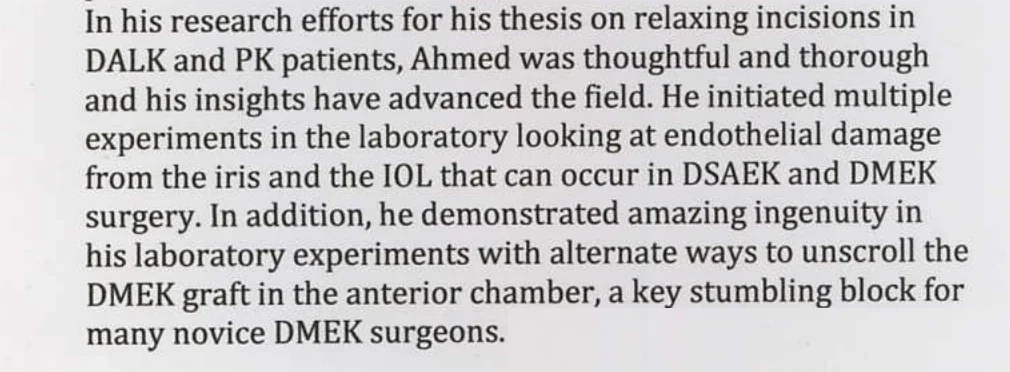
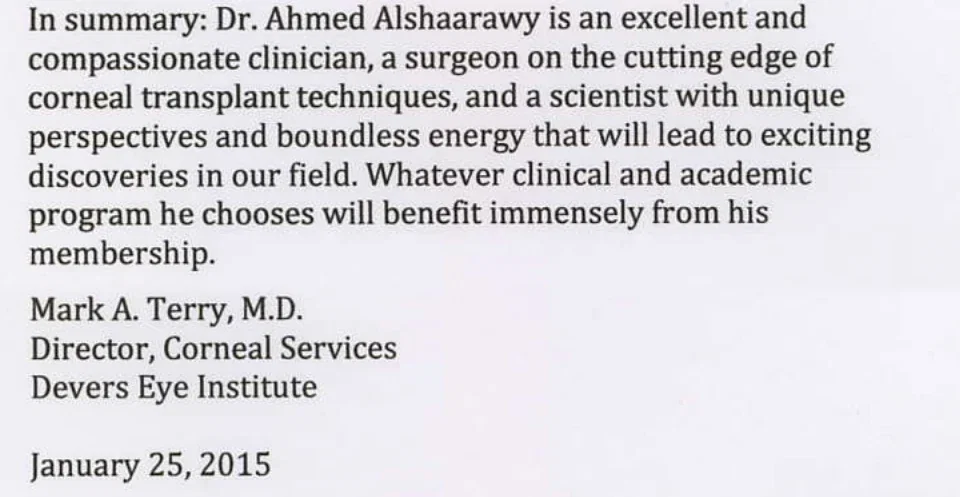
In Prof. Mark Terry's own words
Excerpts from the letter Prof. Mark A. Terry, Director of Corneal Services at the Devers Eye Institute, wrote for Dr. Shaarawy on 25 January 2015, at the end of his time in Portland.
Tripoli, March 2022
Libya's national corneal transplant programme
Visiting surgeon for the programme the Libyan Ministry of Health launched at Tripoli University Hospital: about 20 corneal transplants in one week, restarting the surgery there after a pause of nearly eight years.
The full story and sourcesAn endothelial transplant for a young girl
Dr. Ahmed Shaarawy explains why he chose DSAEK for a child despite lens and iris problems, and why a child's age does not allow delay, with her mother on the experience.
"At this young age the child has to see well before reaching the age of 8."
Procedures & pricing
Transparent USD pricing.
Final cost is set after clinical examination. Local-currency equivalents available on request. Insurance reports issued for international patients.
| Procedure | Best for | From (USD) |
|---|---|---|
| DSAEK (standard) | Conventional DSAEK with a 100-150 micron stromal layer + endothelium. | $3,500 - $4,500 |
| Ultra-thin DSAEK (UT-DSAEK) | Prepared to 50-100 microns. Closer visual outcome to DMEK. | $3,500 - $4,500 |
| DSAEK + cataract surgery (triple) | Combined procedure for Fuchs patients with cataract. | $3,900 - $4,900 |
Watch a real patient's experience with Dr. Ahmed Shaarawy
A real patient goes through the whole case, from diagnosis to restored vision after endothelial corneal transplantation.
Common questions
Frequently asked.
How is DSAEK different from DMEK?
What's the recovery time for DSAEK?
What's the rejection risk?
I had a glaucoma drainage tube. Can I have DSAEK?
How long do I need to be in Cairo?
Can I have DSAEK if I had LASIK or RK before?
Book your consultation
Pick a day and time. The first visit is an eye exam with Dr. Ahmed Shaarawy, who tells you which option suits your eyes.
Send your case for a DSAEK or DMEK recommendation.
We'll review your specular microscopy, OCT, and any prior surgical history and recommend whether DMEK, DSAEK, or another transplant approach is right for your eye, and the all-in cost.
Medical references
- Anshu A, Price MO, Price FW Jr. "Risk of corneal transplant rejection significantly reduced with Descemet's membrane endothelial keratoplasty." Ophthalmology. 2012;119(3):536-540. PMID: 22218143. rejection risk after DMEK significantly lower than after DSEK or penetrating keratoplasty.
- Hos D, Tuac O, Schaub F, et al. "Incidence and Clinical Course of Immune Reactions after Descemet Membrane Endothelial Keratoplasty: Retrospective Analysis of 1000 Consecutive Eyes." Ophthalmology. 2017;124(4):512-518. PMID: 28094043. probability of an immune reaction 2.3% at four years.
- Dr. Ahmed Shaarawy: 20+ years of corneal and refractive surgery, Devers Eye Institute fellowship (Portland, Oregon), two surgical techniques published in the AAO video series. The figures on this page come from the published literature, not from this clinic's own patients.