
PDEK: best of both endothelial worlds.
PDEK (Pre-Descemet Endothelial Keratoplasty) transplants the Descemet membrane, endothelium, and a 30-micron pre-Descemet stromal layer (Dua's layer). The result: visual outcomes close to DMEK with surgical handling closer to DSAEK. Useful in complex eyes, repeat transplants, and when DMEK preparation is difficult.

Why choose us
International standard. Regional access.
Devers-trained endothelial surgeon
Fellowship at Devers Eye Institute under Prof. Mark A. Terry, a leading center for endothelial keratoplasty research and innovation.
AAO 2014 poster on DMEK
Co-authored the AAO 2014 poster on DMEK in corneas with prior refractive surgery (with Mark Terry's group). PDEK is the natural extension of that work.
Right donor, right technique
PDEK is especially useful with young donor tissue (where DMEK preparation can fail). We select the technique based on the donor age and your anatomy.
Lower rejection vs PKP
Like DMEK and DSAEK, PDEK only replaces the inner cornea, leaving the front surface intact and lowering rejection risk dramatically vs full-thickness grafts.
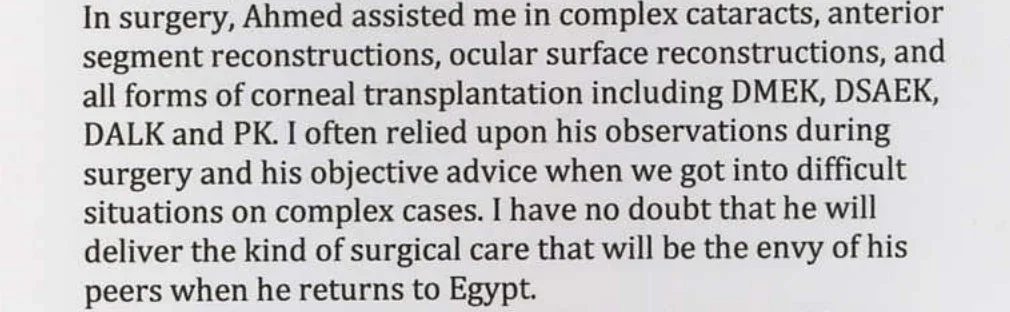
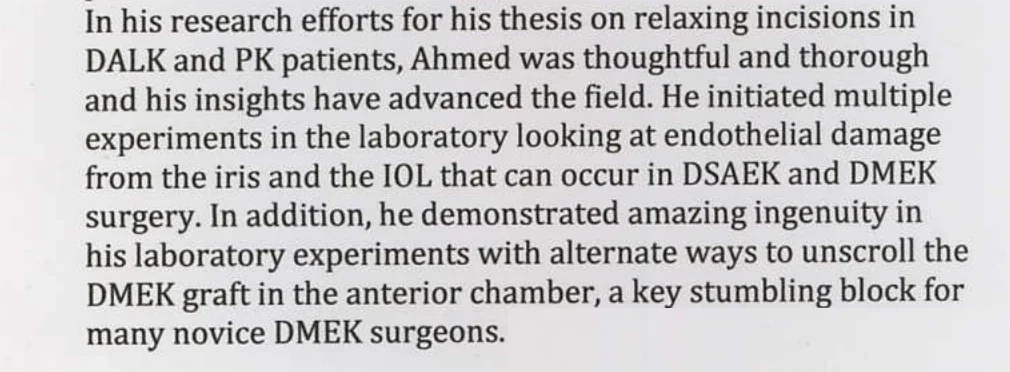
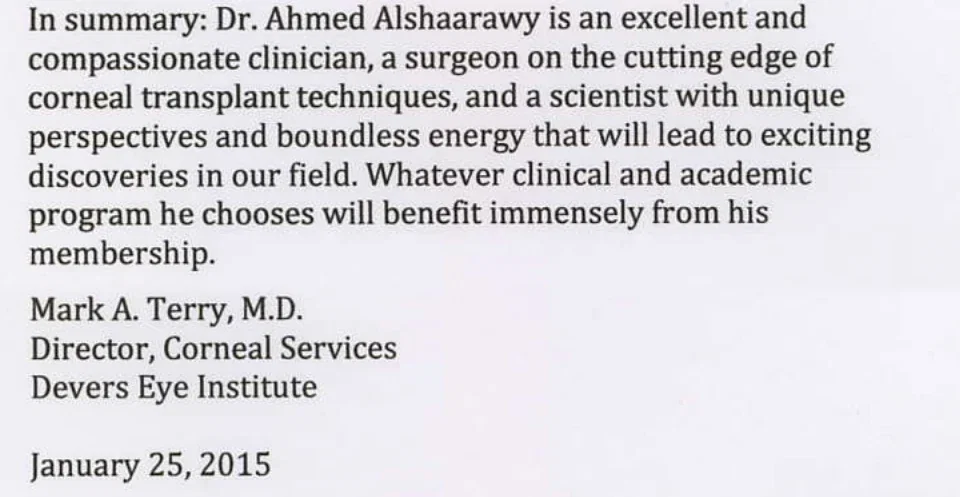
Letter of recommendation
In Prof. Mark Terry's own words
Excerpts from the letter Prof. Mark A. Terry, Director of Corneal Services at the Devers Eye Institute, wrote for Dr. Shaarawy on 25 January 2015, at the end of his time in Portland.

Tripoli, March 2022
Libya's national corneal transplant programme
Visiting surgeon for the programme the Libyan Ministry of Health launched at Tripoli University Hospital: about 20 corneal transplants in one week, restarting the surgery there after a pause of nearly eight years.
The full story and sourcesProcedures & pricing
Transparent USD pricing.
Final cost is set after clinical examination. Local-currency equivalents available on request. Insurance reports issued for international patients.
| Procedure | Best for | From (USD) |
|---|---|---|
| PDEK (standard) | Endothelial keratoplasty, same price band as DMEK/DSAEK; final quote after examination | $3,000 - $3,500 |
| PDEK + cataract (triple) | Combined with phaco + IOL, total depends on the IOL tier you choose | $3,600 |
Watch a real patient's experience with Dr. Ahmed Shaarawy
A real patient goes through the whole case, from diagnosis to restored vision after posterior (endothelial) corneal transplantation.
Common questions
Frequently asked.
How is PDEK different from DMEK?
When is PDEK preferred over DMEK?
What's the recovery time?
Book your consultation
Pick a day and time. The first visit is an eye exam with Dr. Ahmed Shaarawy, who tells you which option suits your eyes.
Send your case for an endothelial-transplant recommendation.
We'll review your specular microscopy, OCT, and any prior surgical history to recommend whether DMEK, DSAEK, or PDEK is the right choice for your eye, and the all-in cost.
Medical references
- Agarwal A, Dua HS, Narang P, Kumar DA, et al. "Pre-Descemet's endothelial keratoplasty (PDEK)." Br J Ophthalmol. 2014;98(9):1181-1185. PMID: 24659352. The paper that first described PDEK: five eyes, graft attachment in every case, mean graft thickness 28 ± 5.6 µm.
- Dr. Ahmed Shaarawy: 20+ years of corneal and refractive surgery, Devers Eye Institute fellowship (Portland, Oregon), two surgical techniques published in the AAO video series. The figures on this page come from the published literature, not from this clinic's own patients.